Red pine
Red pine, also known as Norway pine, is a pine native to Eastern North America, with a distribution from Pennsylvania and the Great Lakes region to Manitoba and Newfoundland. It is an adaptable species, and is a valuable forestry species in its native range. One of only two American member of subsection Pinus, the species is characterized by low genetic diversity.
Red pine is a coniferous evergreen tree characterized by tall, straight growth. It usually ranges from 20-35 metres in height and 1 metre in trunk diameter. The crown is conical, becoming a narrow rounded dome with age. The bark is thick and gray-brown at the base of the tree, but thin, flaky and bright orange-red in the upper crown; the tree's name derives from this distinctive character. Some red color may be seen in the fissures of the bark. The species is self pruning; there tend not to be dead branches on the trees, and older trees may have very long lengths of branchless trunk below the canopy.
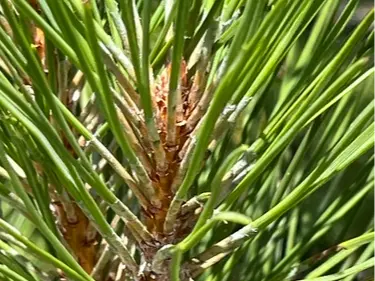
The leaves are needle-like, dark yellow-green, in fascicles of two, 12-18 centimetres long, and brittle. The cones are symmetrical ovoid, 4-6 centimetres long by 2.5 cm broad, and purple before maturity, ripening to nut-blue and opening to 4–5 cm broad, the scales without a prickle and almost stalkless. The red pine grows well in sandy soils and on soils which are too poor for white pine.

.svg)